sensory playpreschoolkids activitiessupervision· 5 min
Sensory Play Activities for Preschoolers: Everything You Need to Know
A practical guide to sensory play activities for preschoolers, with a setup table, a supervision checklist, and official notes on small parts and mouthing.
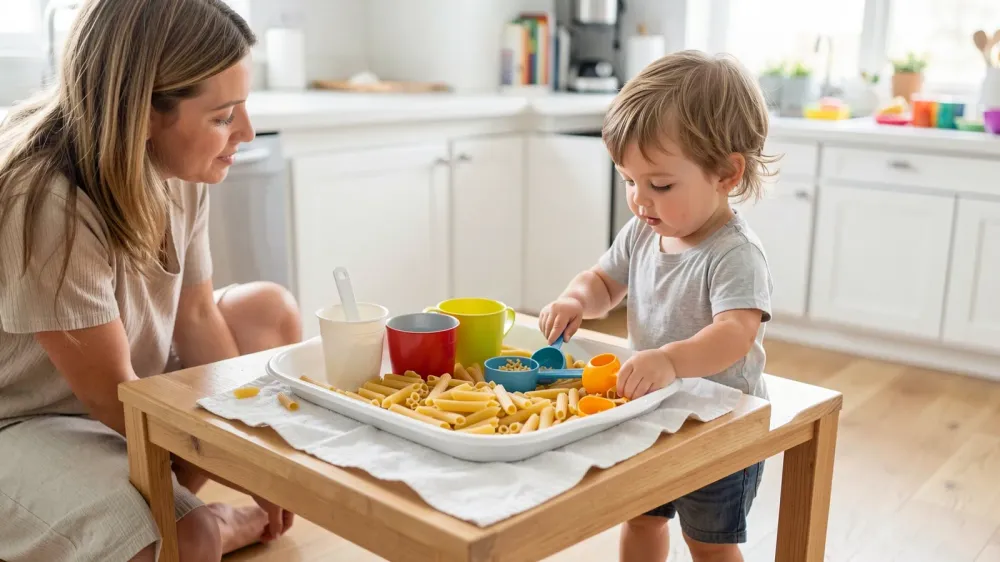
Sensory play for preschoolers is ordinary material, used with attention
Sensory play activities for preschoolers sound like a specialist term. In a kitchen, they usually look like a shallow bin, a scoop, and something to pour or press: dry beans for an older preschooler, warm water and cups, a lump of dough, a tray of ice, or a basket of fabric scraps. The point is not a perfect "sensory diet," and this article will not promise therapeutic results. The point is that children this age often learn with their hands, and a short, contained activity can use that energy instead of leaving it to wander the walls.
In our house, the successful bins are the ones I can set up in five minutes and clean up in ten. The unsuccessful ones are the ones I built from a long list of ingredients, then guarded like a science exhibit. Preschoolers will pour. They will mix two things you hoped to keep separate. If that will ruin your afternoon, choose a smaller tray, a towel on the table, and a material you can sweep or toss.
Supervision is part of the activity, not an extra. Preschoolers still taste things, especially when the material looks like food. Some materials that are fine for a four-year-old at a table are a poor idea if a younger toddler is crawling through the same room.
A practical table of preschool sensory ideas
Match the material to the child, the floor, and the siblings in the room, not to a photograph.
| Activity | Typical materials | Containment | Extra care |
|---|---|---|---|
| Dry pouring | Large dry pasta, big scoops, cups, a shallow bin | A towel under a bin on a table | Skip tiny grains if a younger child might join; spilled dry pasta is easier than spilled flour, until it is stepped on |
| Water play | A low basin, cups, a funnel, a small towel for each child | Outdoors, or a kitchen floor you can wipe; keep water shallow | Stay the whole time; empty the basin when you leave the room |
| Dough | A simple dough you are willing to throw away, a dull cutter, a mat | A washed table or a tray | If anyone might eat it, use an edible recipe you trust, and still sit with them |
| Nature tray | Large pine cones, smooth stones too big to swallow, leaves | A tray with a rim | Wash hands after; avoid berries, thorns, and anything a child might chew |
| Fabric and sound | Scarves, a wooden spoon, a tin, ribbon that cannot wrap tightly around a neck | A basket on the floor with space to move | Skip long cords; stay close during dancing and wrapping games |
| Ice and warm water | Ice cubes in a bowl, a second bowl of cool or barely warm water, spoons | A towel; short session | Test water temperature with your wrist; no boiling water, no dry ice |
Water beads, small beads, and similar products that start tiny or can be swallowed do not belong in a preschool activity if there is any chance of mouthing, and they are a poor choice whenever a younger child shares the space. Head Start reminds adults to review loose parts for choking hazards and to supervise closely as children begin to use materials. Official guidance on materials and mouthing is in Head Start's note on loose parts play and in its young infant safety tips, which also describe the small-parts cylinder test used for children under 3: 2.25 inches long by 1.25 inches wide. The size rule itself is in 16 CFR 1501.4.
If a child has a known allergy, do not use that food as a play material. "It is only play dough" is not a reason to put a trigger on the table. When in doubt, choose water, fabric, or a food-free dough recipe, and ask the child's clinician about any special concern rather than improvising a treatment.
How to set up a session that actually ends well
Put the bin on a table when you can, not in the middle of a rug you love. Offer two tools, not twelve. Say, in ordinary words, what may be poured and what may not, including "this stays in the bin" and "we do not eat this." Then stay. A preschooler exploring rice for the first time will test the edge of the towel. That is the session, not a misbehavior that has to ruin the day.
Keep sessions short. End while there is still some interest, so you are not peeling a child off a bin they have already turned into a spill. Have a dirty-towel plan and a hand-washing step at the end. If the child wants to help sweep, that can be the last part of the play.
Clothes you do not care about are a form of containment too. A "play shirt" saves more arguing than a warning not to splash.
A checklist for sensory play activities for preschoolers
- The material is a sensible size for every child who can reach the bin
- You have a towel, a tray with a rim, or an outdoor surface
- You can stay and watch the whole time, especially with water
- Food allergens for anyone in the house are not in the recipe
- Water beads, tiny beads, and other easy-to-swallow fillers are out
- The basin will be emptied and put away when you leave the room
- Hands will be washed after messy play, and the floor will be checked for stray pieces
- You have a short time in mind and a calm way to end
- A younger sibling has a separate, safer activity, or is on your lap, not unsupervised on the floor under the table
If you cannot tick supervision and small-parts lines, choose coloring, large-block play, or a walk instead. Sensory play is optional. A safe afternoon is not.
Questions about sensory play for preschoolers
What are easy sensory play activities for preschoolers on a weekday?
A shallow bin of large dry pasta with two cups, a tray of dough, or a basin of water with a funnel are enough. You do not need a themed table. You need a rimmed tray, a towel, and ten minutes of your attention.
Is flour or dry rice a good first filler?
They are common, and they are messy. Rice and flour also tempt tasting, and spilled flour is slippery. If you use them, keep the child sitting at a table, watch the mouth, and sweep carefully. Large pasta or water can be a calmer first try.
How is preschool sensory play different from infant sensory play?
Preschoolers can often scoop, pour, and follow a simple "it stays in the bin" rule, and they can use slightly more complex tools. Infants need an even stricter materials list, no small parts, and closer handling of their bodies. Do not hand a baby a preschool rice bin.
My child only wants to dump the whole bin. Is the activity failing?
Dumping is a way of learning about the bin. Offer a smaller amount of material, a larger tray, and one more chance to fill a cup. If dumping still ends the session, it ended, and you can try a smaller setup tomorrow.