preschoolcoloring pageskids activitiessmall parts safety· 6 min
Preschool Coloring Pages: Beginner's Guide
This beginner's guide to preschool coloring pages covers simple setups, age-sensible tools, a family checklist, and official small-parts safety notes.
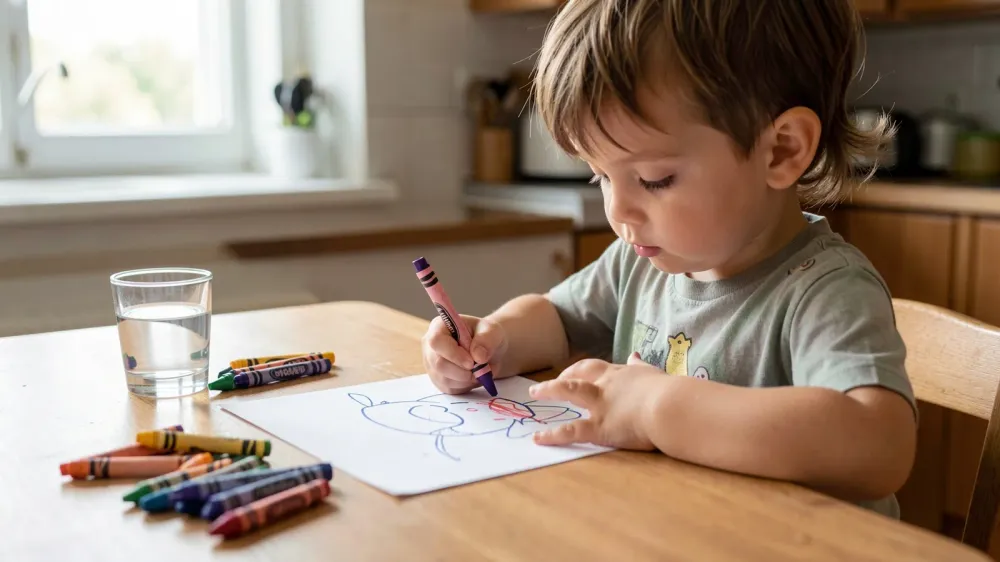
A coloring page is a short, sit-down invitation
Preschool coloring pages work best when you treat them as a short invitation, not as a curriculum or a test of talent. A four-year-old who will sit with a single page and a small pile of crayons for ten minutes has had a good session. A child who scribbles over the lines, flips the page, and asks for a snack has also had a good session. The point is marks on paper, a chance to sit, and a chance to talk about colors, animals, or whatever is in the picture, not a polished refrigerator gallery.
In our house, the days coloring goes well are the days I set out too few materials, not too many. A thick pad of paper, eight crayons, and a clear table edge beat a huge pile of markers that roll onto the floor. The days it goes badly are the days I expect a quiet half hour while I cook, then get annoyed when the child stands up after four minutes. Preschool attention is short. Plan for short, and you will both be kinder.
Coloring is generally a seated activity. That matters more than it sounds. Children should not walk around with crayons in their mouths, and younger preschoolers still put things in their mouths when they are busy or tired. Keep the crayons large enough, sit together, and put the work down when the mouthing starts.
Choose pages and tools that fit the child you have today
"Preschool" covers a wide spread. A child who has just turned three and a child who is almost five can both be preschoolers, and they will not want the same page. Fine lines and tiny shapes frustrate some children and delight others. Start simple, then offer a busier page if they ask for one.
| Choice | A gentle starting point | What to watch for |
|---|---|---|
| Page complexity | Large shapes, a single main figure, not much tiny detail | A page so busy the child gives up, or a page so empty they feel bored after two marks |
| Paper | Ordinary printer paper or a thick pad that will not tear with hard strokes | Flimsy paper that bunches, or a glossy page that rejects crayon |
| Drawing tools | Fat crayons or preschool-size pencils; washable crayons if walls are a known risk | Hard, thin pencils for a child who still grips with a fist; scented tools that invite tasting |
| Markers | Washable, capped, and only if the child will not chew the felt tip | Permanent markers, leaking barrels, or uncapped markers in a bag |
| Place to sit | A table and chair that let feet rest, or a booster that is stable | Coloring lying on the stomach with crayons near the mouth, or standing on a chair to reach |
| Time | A short offer, with an easy way to stop and return later | A promise of "until this whole book is done" |
Printed pages from a trusted source, a simple coloring book, or a page you draw yourself with one big shape are all fine. You do not need a special subscription. If you print at home, look at the picture first. Avoid pages that are mostly advertising, and avoid very small parts of a picture that might suggest "cut this out" if scissors are not a skill you want to introduce that day.
For children under 3, the U.S. Consumer Product Safety Commission treats objects that fit entirely into a small-parts cylinder 2.25 inches long and 1.25 inches wide as small parts. Broken crayon stubs, marker caps, and toy-like erasers can fall into that category. If a younger sibling shares the room, keep the tray up high when you are not sitting with them. Head Start's infant safety guidance makes the same basic point in a different setting: keep objects that can fit in a young child's mouth out of reach, and inspect materials so loose parts cannot come off. Official pages are here: the CPSC discussion of 16 CFR 1501.4, and Head Start's tips for keeping young infants safe.
A simple setup that you can repeat on a weekday
You do not need an art studio. You need a cleared rectangle of table, a smear of protection if the child loves to press hard, and a plan for the end of the session.
Put a washable mat, an old newspaper, or a large sheet of paper under the coloring page. Offer two or three colors to start, then more if they ask. Sit close enough that you can see a crayon heading toward a mouth or a marker heading toward a sleeve, and talk about the picture if they want to talk. If they do not, quiet is allowed.
When the session ends, cap the markers, drop stubby broken crayons into a closed pot, and put the page somewhere obvious so the work is not thrown away by accident. A low magnet on the fridge is enough. You do not have to display every page. You do have to avoid turning the afternoon into a critique. "You used a lot of blue" is a kinder sentence than "trees are not blue."
If more than one child is coloring, give them enough space that elbows do not become the activity. Shared tins of crayons work until they do not. Two small tins prevent more arguments than a lecture about sharing.
A preschool coloring checklist
- The page has large enough shapes for this child's current patience
- Tools are in good condition, not broken into small stubs a younger sibling could mouth
- Marker caps and tiny extras are accounted for, especially if a child under 3 is around
- The child has a stable seat and a clear table surface
- You can stay close enough to supervise, even if you are also folding laundry nearby
- There is a short, realistic time in mind, with no test at the end
- You have a way to dry or store a finished page without smearing it onto a sofa
- Anyone with a known crayon or marker chewing habit has a tool that is less tempting to taste
- The floor around the chair is clear enough that a dropped crayon is easy to find
If you cannot supervise, this is not the moment for markers. Put the tray away and offer a board book or a large-piece activity instead.
What coloring is not for
It is not a therapy promise, a handwriting guarantee, or a way to keep a child silent through a long adult phone call. It can support fine motor practice in an ordinary way, the same way stacking cups or tearing paper can, and it can be a calm habit before dinner. If a child refuses coloring for weeks, that is information, not a failure. Offer stickers, chalk on a pavement, or helping to stir batter, and try a page again later.
If a child consistently chews materials, switch to larger tools, shorten the session, and keep watching. If you have a specific concern about chewing, swallowing, or development, that is a question for the child's clinician, not for a coloring article.
Questions families ask about preschool coloring pages
How many preschool coloring pages should we do in a day?
There is no official number, and you do not need one. One page, done with some attention, is plenty. A child who wants a second page can have one. A child who walks away halfway is allowed to stop.
Are printed coloring pages better than a coloring book?
They are just easier to throw a mat under, and easier to let go of if a page gets soaked. A book is handy for travel if the pages are sturdy and the tools stay in a closed case. Choose by cleanup and the child's grip, not by a trend.
What if my preschooler only scribbles?
That is still coloring. Scribbles are how many children start. Offer a simpler page, thicker tools, and a comment about the motion or the color, not a request to stay inside the lines.
Can I leave a child alone with crayons while I cook in the next room?
Stay close enough to see and hear them, especially if markers, caps, or a younger sibling are involved. A short, supervised session is safer than a long unsupervised one. If you need both hands on a hot pan, bring the child into the same room with a safer activity, or wait until the pan is off the heat.