Thanksgivingkids activitiesfamily holidaykitchen safety· 6 min
Children's Activities for Thanksgiving: A Practical Guide
A practical guide to children's activities for Thanksgiving, with a short activity table, a day-of checklist, and official notes on choking and small parts.
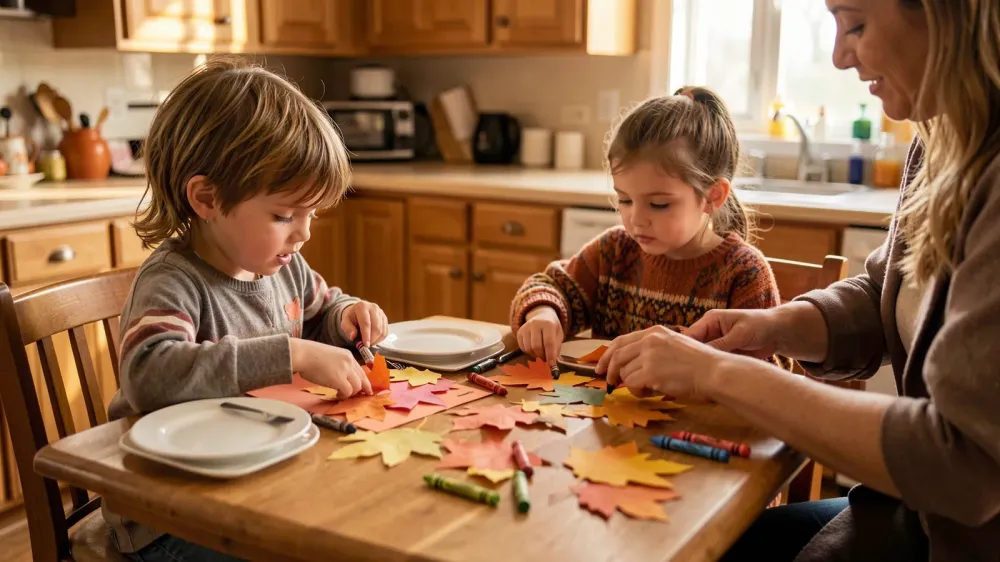
Thanksgiving with children is a day, not a production
Children's activities for Thanksgiving work better when they are small and repeatable, not when they try to fill every hour before a meal. A child who helps put spoons on the table, colors one leaf, and takes a short walk around the block has had a full holiday morning. A child who is asked to perform a long craft, stay clean, and wait quietly for hours has had a long morning, and it will show.
In our family, the activities that survive from year to year are the ones that can stop when a guest arrives or when a toddler melts down. A paper chain can lose a loop and still look like a chain. A nature walk can last eight minutes and still count. A "grateful list" can be three words, spoken out loud, with no handwriting required.
Food is part of the day, and food needs its own care. The Centers for Disease Control and Prevention reminds families that children can choke even after they are feeding themselves, and that sitting up to eat, without walking or lying down, matters. Hard, round, or sticky foods are a particular concern. Cut food to a sensible shape for the child in front of you, keep mealtimes calm, and watch what goes into little mouths. The official guidance is on CDC's choking hazards page. This is not a menu, and it is not medical advice. It is a reason not to hand a running child a handful of whole nuts or a hard candy "to keep them busy" while you stir gravy.
A practical menu of activities, by energy level
Think in two columns: activities that use the hands at a table, and activities that use the legs outdoors or in a hallway. Mix one of each, and leave room for a rest.
| Activity | What you need | Who it tends to suit | How it can stop early |
|---|---|---|---|
| Simple coloring or leaf rubbings | Paper, crayons, a few leaves if you have them | Preschool and early school age | One page is enough; leftover leaves go in a bowl |
| Paper chains or paper place cards | Strips of paper, glue stick or tape, a marker | Older preschoolers and up, with help on glue | A short chain still decorates a chair |
| Setting a low table job | Napkins, spoons, a clear "your part" | Children who want to help in the room but not at the stove | The job can be two napkins, then done |
| A short neighborhood walk | Coats, a bag for a few safe-to-touch finds | Almost any age, with a stroller if needed | Turn around at the corner |
| A spoken "what I liked this year" | No materials | Anyone who wants to talk, including shy children who may only say one word | Passing is allowed |
| Quiet book or puzzle corner | A familiar book, a floor cushion, a simple puzzle | Children who are done with company | This is the exit ramp, not a punishment |
Skip anything that needs a hot glue gun at a crowded table, a craft knife, or small beads if a child under 3 will be on the floor. The CPSC small-parts cylinder, 2.25 inches long and 1.25 inches wide, is a useful mental test for leftover craft bits; objects that fit entirely inside it are treated as small parts for children under 3. Official size rules are in 16 CFR 1501.4.
Kitchen "helping" should be real and limited. Washing a potato, tearing lettuce, or stirring a cold bowl at a table is helping. Standing on a chair over a hot pan is not a Thanksgiving activity. If you want a child in the kitchen, give them a stable standing place away from the oven door, or a job at the table, and keep pot handles turned in.
A day-of checklist that leaves room for the meal
- You have chosen one table activity and one movement activity, not a full program
- Craft materials have been checked for small parts if a toddler will be present
- There is a quiet corner with a familiar book or toy
- Food for children will be served with them sitting down, in pieces that suit their chewing
- Hard candy, whole nuts, and similar "keep them quiet" foods are not the babysitter
- Outdoor plans have a weather backup, such as a hallway parade or a dance to one song
- Any kitchen job is away from heat, and a grown-up is actually watching
- You have told the child, in ordinary words, when the meal will happen, so the wait is not a mystery
- Photographs are optional; the child does not have to pose in an outfit they already hate
If guests are arriving, put the glue away before the doorbell. A half-finished chain is more peaceful than a glue stick on a coat.
What we have learned the hard way
We once tried a long, multi-step centerpiece "for the children to do" while two adults cooked. The centerpiece became a negotiation, then a spill, then a reason someone cried before the meal. The next year we put a bowl of crayons and a short walk on the plan, and the day was kinder. The lesson was not that crafts are bad. It was that Thanksgiving already has a large task in the kitchen, and children's activities should be light enough to drop.
We have also learned not to force a gratitude speech. Some children will say "Grandma" or "my truck" and that is a complete offering. Some will say nothing in a crowded room and later tell you in the car. Leave a door open, not a spotlight.
If the holiday is hard for your family this year, shrink the plan further. A sandwich, a walk, and one page of coloring is still a day. You do not owe a magazine table.
If you are traveling to someone else's house, pack a small "quiet bag" you already know works: a familiar book, a small coloring pad, a closed crayon case, and one comfort toy that does not have loose parts. Do not open a brand-new, complicated craft in a relative's living room and hope it will occupy an hour. New toys can be exciting and overstimulating at the same time, and you will be the person picking tiny pieces out of a rug. Tell the child, ahead of the car ride if you can, what the plan is: travel, hello, a short activity, meal, and a chance to step outside or into a quiet room. Predictability is a better Thanksgiving gift than a surprise activity box.
Questions about children's activities for Thanksgiving
What are good children's activities for Thanksgiving if we are in a small apartment?
A paper chain, a coloring page, a window-sill "what we found" bowl, and a hallway walk or a dance in the living room are enough. You do not need a yard. You need one table job, one chance to move, and a quiet corner.
How do I include a toddler and an older child in the same activity?
Give them the same theme and different tools. The older child can write a place card; the toddler can scribble on a large sheet or carry napkins with you. Keep small pieces off the floor, and do not expect the same finished look from both.
Can children help cook the Thanksgiving meal?
They can help with cool, simple jobs if a grown-up is paying attention: washing produce, tearing herbs, stirring a cold mixture, putting spoons out. Keep them away from hot oil, oven doors, and sharp knives. Helping is not the same as being parked in a busy kitchen unsupervised.
What if the child is shy and does not want a "thankful" activity?
Let them skip it. Offer a quiet book, a simple coloring page, or a job with their hands. Gratitude exercises are optional. A peaceful child at the table is already a gift to the day.