infant playsensory playtummy timebaby safety· 6 min
Infant Sensory Play: Everything You Need to Know
Everything you need to know about infant sensory play: floor-level ideas, a close-supervision checklist, and official small-parts and tummy-time guidance.
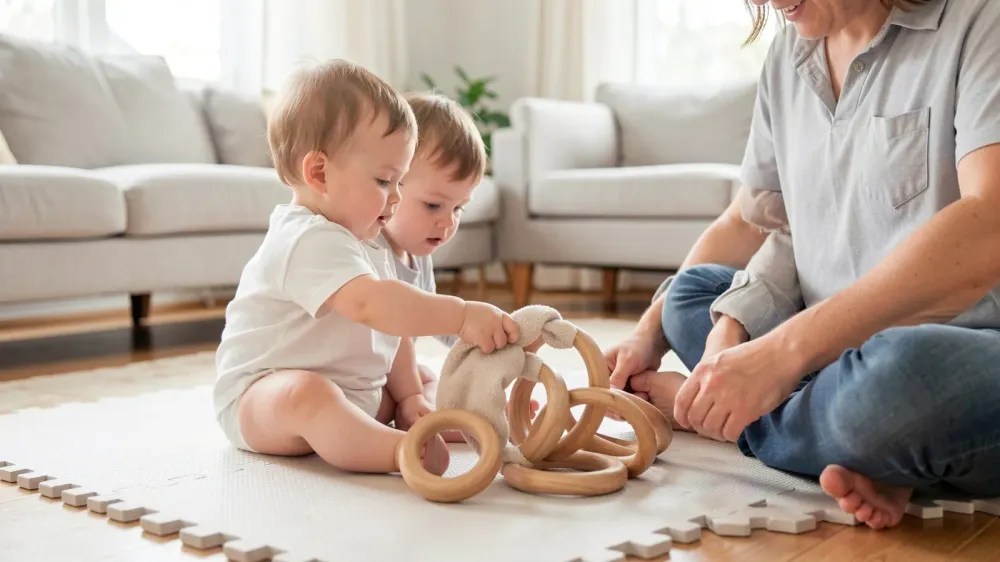
Infant sensory play is close, slow, and closely watched
Infant sensory play is not a smaller version of a preschool sensory bin. A baby who is still mouthing everything, who may not yet sit steadily, and who cannot follow a rule about "leave it in the tray" needs a different setup. The useful version is often you, the baby, and one or two safe things to look at, touch, or listen to, on a firm, clear surface, with your hands ready.
This is not a treatment plan, and it is not a promise about development. It is a set of ordinary ideas: a chance to feel a soft cloth, watch a shadow, hear a rattle that cannot come apart, or spend a few minutes on the tummy while you stay close. Head Start notes that young infants need a safe space for supervised tummy time, and that caregivers should use equipment and materials with no small parts, because babies grasp and mouth objects. Official guidance is in Head Start's tips for keeping young infants safe. The same page points to the small-parts cylinder used for children under 3: 2.25 inches long by 1.25 inches wide. The size test is set out in 16 CFR 1501.4. If an object can fit entirely in that cylinder, it is too small for infant play.
Falls matter too. Head Start notes that young infants begin to roll and move in unexpected ways, and that close supervision helps prevent falls. A changing table, a sofa edge, or a bed is a poor play surface for this reason. Use the floor, with a clear mat, and stay.
What to offer, and what to leave in the cupboard
Keep the list short. One new texture at a time is plenty. If the baby turns away, the activity is over, even if you just set it out.
| Idea | What it can look like | What makes it safer | When to stop |
|---|---|---|---|
| Supervised tummy time | A firm mat on the floor, you lying in front of the baby, a single simple toy out of reach or at the edge | Bare or sure footing, no pillows that cover the face, no loose blankets bunched near the nose | As soon as the baby is distressed, or you need to leave the room |
| Soft cloth play | A clean muslin or a soft scarf with no beads, held by you | No long cords, no detachable decorations, fabric you can wash | If the cloth covers the face or the baby mouths something you do not trust |
| Sound | Your voice, a rattle that is intact and too large to swallow, a crinkle fabric sewn closed | Shake and pull the toy before each use; nothing that can crack into pieces | If a seam splits or a part loosens |
| Temperature and air | A slightly cool, clean spoon for an older infant to touch, or a walk near a window with you holding the baby | No ice packs on skin, no hot objects, no unsupervised outdoor time | At the first sign of discomfort |
| Water, only with your whole attention | A thin film of water in a wide, shallow tray, or a wet washcloth | Stay touching the baby; tiny amounts; never a deep basin; never a moment of "I will just get a towel" | The moment you cannot have both hands available |
| Everyday watching | You folding cloths, a slow walk, a view of leaves | The baby is held or lying on the floor, not unattended in a seat on a table | When the baby is tired, hungry, or overstimulated |
Leave out water beads, small natural objects such as beans, nuts, or acorns, plastic bags, balloons, button-eyed toys, and anything that can break into a piece that fits in the mouth. "Sensory play activities for infants" on social media often show bins that belong, if they belong anywhere, with much older children. Do not copy a preschool rice table for a baby.
If a toy is marketed for infants, still inspect it. Pull the eyes, test the seams, and throw it out of the rotation if it starts to fail. Official product recalls are worth checking when a toy seems poorly made, but inspection in your own hands is the daily habit.
A floor-level checklist for infant sensory play
- The baby is on a firm, clear floor surface, not a high sofa or bed
- You can stay within reach for the whole activity
- Every object has been checked for loose parts and is too large to fit the small-parts test
- There are no cords, bags, balloons, or water beads in reach
- Tummy time, if you offer it, is supervised and ends when the baby has had enough
- Water, if you offer it at all, is shallow and you are not leaving the room
- Pets and older siblings with small toys are not unsupervised in the same space
- Hands and the toy can be cleaned, and you will wash the baby's hands after mouthing fabric or toys
- You have a calm end point: a hold, a feed, or a rest, not one more toy
If you are tired enough that supervision will slip, skip the special materials. Holding the baby and talking is already sensory play, and it does not drop small parts on the floor.
A few honest notes from ordinary days
We have had more success with a wooden spoon and a metal bowl, used while I sit on the floor, than with any elaborate "infant sensory kit." The kits often include too many pieces and at least one item I do not trust. A single sound, a single cloth, and my face at the baby's level have been enough.
We have also learned to put older children's small toys away before putting the baby down to play. A preschooler's bead, left under a chair, can become the most interesting object in the room. Sensory play for infants is as much about what you pick up as about what you set out.
If you have questions about a baby's vision, hearing, muscle tone, or a specific medical condition, ask the child's clinician. Do not use a play article as a diagnosis or a therapy plan.
Questions about infant sensory play
When can I start infant sensory play?
You can start with ordinary, supervised experiences early: your voice, a view of your face, a clean cloth, and, when you are both ready, short supervised tummy time on a firm surface. You do not need a formal start date or a kit. Follow the baby's cues and official safe-sleep and safe-play habits, including a clear, firm surface and no loose objects in a sleep space.
Are sealed bags of hair gel or "sensory pouches" a good infant toy?
A sealed pouch can leak or tear, and the filling is not something you want in a mouth or an eye. If you use any pouch at all, stay in control of it, inspect it, and throw it away at the first sign of damage. Many families will be happier with a solid rattle and a cloth.
Can I use a screening session or a phone video as infant sensory play?
A person in the room, a real object, and your voice are the better tools. This article will not promise outcomes from screens, and it will not treat a video as a stand-in for supervised play on the floor.
What should I do if my baby gags on a toy or a bit of fabric?
Take the object away, stay with the baby, and follow the advice you have already received from your clinician or from official infant first-aid training if the baby is in distress. Afterward, look at why the object was small enough or loose enough to be a problem, and change the materials. For first-aid skills, use an official training course rather than a memory of a video.